Blogs
Holistic Progress Card: From Marks to Growth
“More than 60% of students forget what they learn after exams.”
That number should worry us. It also tells us something simple. Marks are not learning. For years, we have used report cards to judge students. One number. One rank. One label. But real growth is never that small. It is messy, slow, and different for every child. This is where the holistic progress card changes everything.
Holistic Progress Card: What Are We Really Measuring?
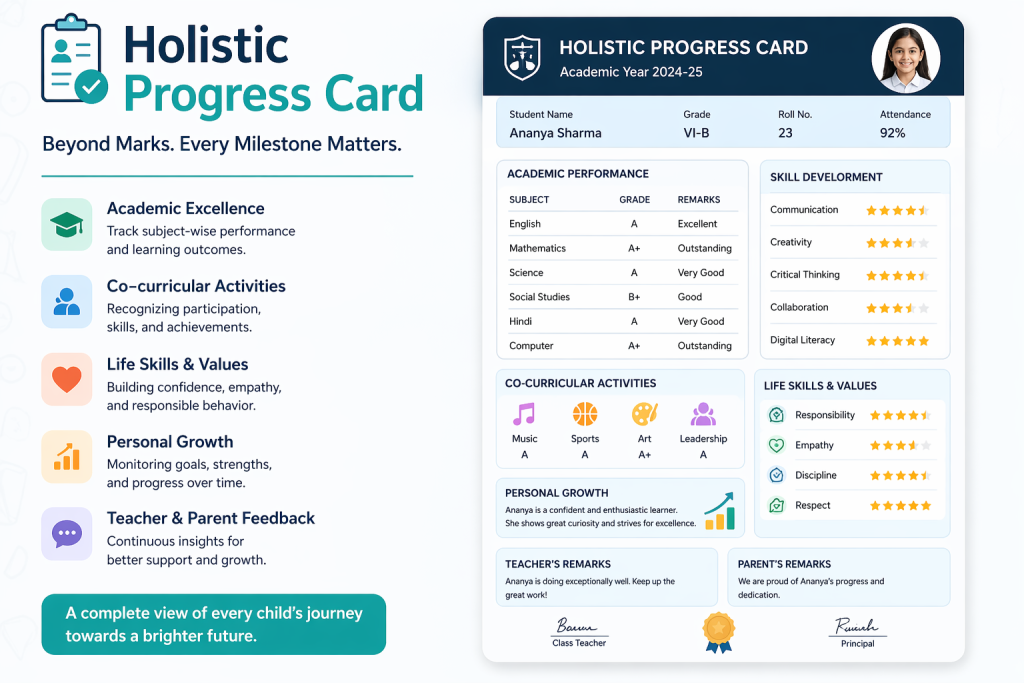
A holistic progress card is not just about marks. It is about the full picture of a student.
It looks at:
- What a student knows
- How a student thinks and behaves
- How a student improves over time
So instead of asking, “How much did you score?”
It asks, “How are you growing?” And that shift matters. A lot.
Because a student who scores 70 but improves every week is very different from a student who scores 90 and stays stuck.
Holistic Progress Card: Why Marks Alone Don’t Work
Marks feel simple. That is why we trust them. But simple is not always right.
Marks only show:
- Memory, not understanding
- Speed, not thinking
- Performance on one day, not progress over time
Also, marks create pressure. Students start chasing numbers, not learning. They stop taking risks. They stop asking questions. As a result, classrooms become quiet. But not in a good way. A holistic progress card, on the other hand, rewards effort, curiosity, and improvement. It tells students that growth matters more than perfection.
What Makes a Holistic Progress Card Powerful
Now let’s get practical. A good holistic progress card is not just a fancy idea. It has clear parts.
Here is what it should include:
Continuous Progress Tracking
Not once a term. Not once a year. But all the time.
- Small assessments
- Practice data
- Class participation
- Project work
This helps teachers see patterns early. And act fast.
Skill and Concept Mapping
Every subject is broken into small parts.
- Strong areas are clear
- Weak areas are visible
- No guesswork
So instead of saying “good in maths,” we say:
Strong in algebra, needs help in fractions.
That is useful. That drives action.
Feedback from Many Angles
Growth is not one voice. There are many.
- Teacher feedback
- Self-reflection
- Peer feedback
This builds awareness. Students start understanding themselves better.
Focus on Improvement, Not Just Results
This is the heart of a holistic progress card. Track
- Efforts
- Consistency
- Growth over time
Even small wins are seen. And that builds confidence.
How Schools Can Start Using Holistic Progress Cards
This is where many schools get stuck. The idea sounds good. But how do you actually do it?
Start simple.
Step 1: Break Subjects into Skills
Do not track marks only. Track skills inside each subject.
Step 2: Use Regular Low-Stakes Assessments
Short tests. Quick checks. Daily practice.
This reduces fear and gives more data.
Step 3: Record Observations
Teachers should note:
- Participation
- Curiosity
- Effort
These matters more than we admit.
Step 4: Share Progress Often
Do not wait for report day.
- Weekly updates
- Monthly summaries
- Parent dashboards
Make growth visible.
Step 5: Turn Data into Action
Data is useless if it sits idle.
- Give targeted practice
- Offer support where needed
- Challenge advanced learners
This is where real change happens.
The Real Impact of a Holistic Progress Card
When done right, a holistic progress card changes the classroom.
Students:
- Take more ownership
- Fear failure less
- Focus on learning
Teachers:
- Teach with clarity
- Intervene early
- Personalise learning
Parents:
- Understand their child better
- Support learning at home
It becomes a system of growth. Not judgment.
Where Technology Makes It Work
Let’s be honest. Doing all this manually is hard. Very hard. Tracking every student. Every skill. Every day. It takes time.
This is where platforms like Schoolnet’s Geneo step in. Geneo turns the holistic progress card into a live system.
- Real-time tracking of learning outcomes
- Clear skill-wise insights
- AI-based suggestions for improvement
- Easy dashboards for teachers and parents
So instead of creating reports, schools can focus on improving learning.
From Marks to Meaning
Marks are easy to print. Growth is harder to see. But growth is what truly matters. A holistic progress card helps us move from judging students to understanding them. From ranking them to supporting them. From marks to meaning. And once that shift happens, classrooms don’t just perform better. They become places where students actually learn.

Social Media Links


