Blogs
EdTech for School: What Actually Works in Real Classrooms
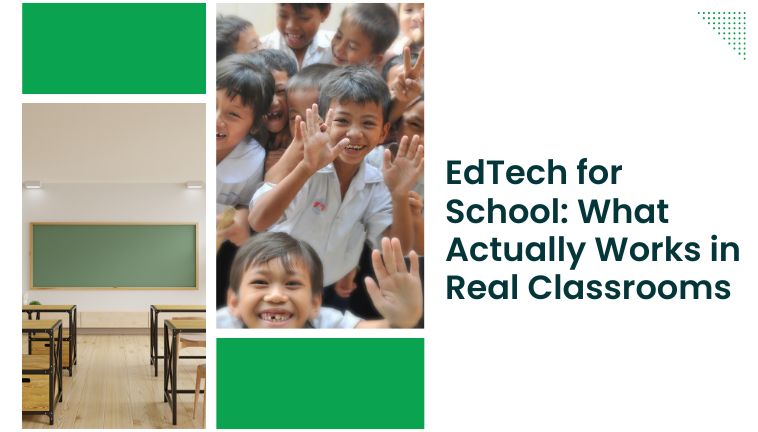
A school can buy the best technology in the world. Still, learning may not improve. That is the uncomfortable truth many educators quietly admit today. According to multiple global education reports, over 60 percent of EdTech investments fail to show a visible classroom impact. Not because technology is bad. However, it is often used incorrectly. This is where the real conversation on EdTech for School must begin.
Not with tools. But with classrooms.
EdTech for School Is Not About Devices
Most people think EdTech for School means smart boards, tablets, apps, or AI tools.
That thinking is incomplete.
In real schools, technology works only when it solves daily problems that teachers and students face. If it adds confusion, pressure, or extra work, it quietly fails.
Effective EdTech for School focuses on:
- Making lessons easier to explain
- Saving teacher time
- Helping slow learners without labeling them
- Keeping learning active, not passive
If a digital tool does not do at least one of these, it becomes noise.
The Classroom Reality Schools Often Ignore

Let us be honest for a moment. Teachers are already stretched. Students are distracted. Administrators want results. Parents want clarity.
EdTech for schools must work inside this reality, not in theory.
So what actually helps?
- Visual explanations instead of long lectures
- Ready-to-use lesson support instead of extra planning
- Simple dashboards instead of complex reports
- Content that matches the syllabus, not fights it
Technology should fit into the school day. Do not demand a new one.
EdTech for School That Teachers Trust
Here is a simple rule. If teachers trust it, students benefit. Teachers adopt EdTech for School when it:
- Works even with low internet
- Does not replace them
- Helps them manage mixed learning levels
- Makes revision easy
When teachers feel confident, classrooms change. When they do not, devices gather dust.
Trust is built slowly. Through training, support and simplicity.
Small Wins Matter More Than Big Claims
Many EdTech solutions promise transformation. But real impact comes from small wins.
For example:
- A student understands fractions better using visuals
- A teacher saves ten minutes every period
- A shy learner participates in digital quizzes
- A class revises before exams without stress
These moments rarely appear in brochures. Yet they define success. Good EdTech for School is quiet. Consistent. Reliable.
How Schools Can Choose EdTech for Schools Wisely
Before selecting any solution, schools should ask five simple questions.
- Does it work with our curriculum
- Can teachers use it without fear
- Will students stay engaged beyond the first week
- Can it run with weak connectivity
- Does it show learning progress clearly
If the answer is unclear, pause. EdTech for schools should reduce risk, not add it.
Technology Should Support Learning, Not Speed It Up
There is a rush to move faster. Finish the syllabus. Add more content. Track more data.
But learning does not work on speed alone. EdTech for schools should slow things down where needed. Give space to revise. Allow students to learn at their own pace. Help teachers spot gaps early.
Depth beats speed. Always.
What the Future of EdTech for School Looks Like
The future is not flashy. It is practical.
EdTech for School will focus on:
- Blended classrooms, not fully digital ones
- Teacher-led innovation, not tool-led change
- Simple analytics, not complex dashboards
- Equity across urban and rural schools
The best technology will feel invisible. Learning will be visible.
Where Schoolnet Fits In
At Schoolnet, we have learned this the hard way. Over years of working with schools across different contexts, one lesson stands out. EdTech for schools works only when it respects classrooms, teachers, and students equally.
Our focus has always been on:
- Curriculum-aligned solutions
- Teacher confidence, not dependency
- Learning continuity, even with low connectivity
- Measurable classroom impact
Technology is a means. Education is the goal.
Conclusion
EdTech for School is not about chasing trends. It is about choosing what helps children learn better, every day. When technology listens to classrooms, schools move forward.

Social Media Links


